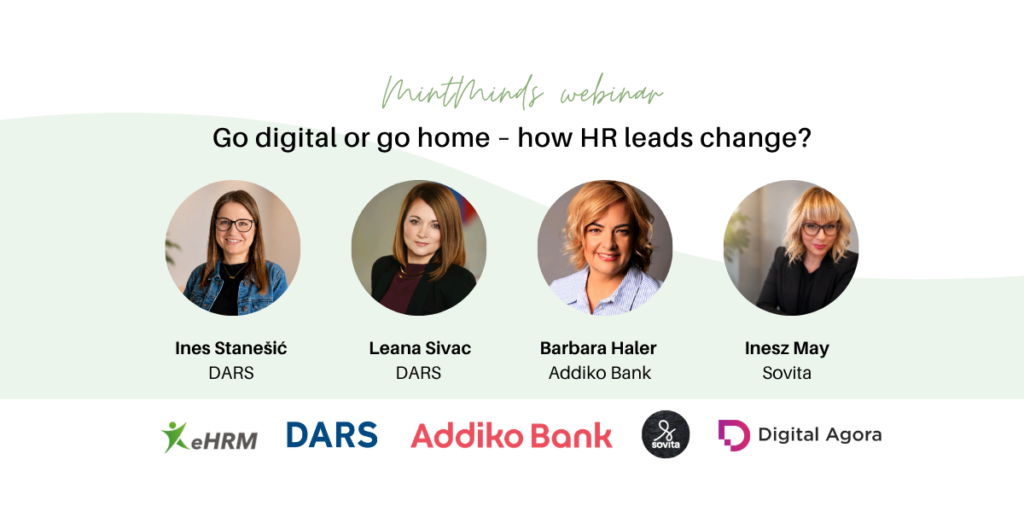
This was exactly the topic of our MintMinds webinar, Go Digital or Go Home – How HR Leads Change?, where Barbara Haler, Head of Legal, HR and Organizational Culture at Addiko Bank, Leana Sivac, Head of Human Resources Management at DARS, Ines Stanešić, HR Specialist at DARS, and Inesz May, HR Development, Learning and Employer Branding Specialist at Sovita, shared their experiences and lessons learned.
Every organization approaches change differently. During the webinar, we heard three very different stories and gained insight into how digitalization and change management look in practice in organizations with completely different work environments. From a company where every employee has a computer, to one where most employees work in the field, and another where communication happens primarily through mobile phones.
Despite these differences, one conclusion was shared by all speakers: digitalization is not primarily a technology project. It is a people project. It is about changing habits, improving processes, and helping employees embrace new ways of working.
Digitalization doesn’t start with a system
When we talk about digitalization, the conversation often begins with selecting a new tool. In reality, successful digitalization starts much earlier.
Addiko Bank has been using eHRM for more than 15 years. For a long time, however, the system was used mainly by the HR team. Over time, they realized that HR was spending too much time answering managers’ questions and providing information that already existed within the system. The data was there, but managers did not have direct access to it, so HR often acted as the middleman.
To change this, they gradually opened eHRM to managers, giving them direct access to the reports and information they needed. But they quickly learned an important lesson: introducing a system does not automatically change behavior. Even when information was available in the system, some people still preferred to call HR.
This is where consistency becomes crucial. Instead of looking up the information and sending it by email, HR guided employees to the right place in the system and showed them how to find it themselves. These small changes in everyday habits may seem insignificant at first, but over time they create the biggest impact.

Every company faces different challenges
DARS employs around 1,300 people, with approximately half of them working in maintenance and spending most of their time in the field. Employees are spread across nine locations throughout Slovenia and work under various schedules, from regular office hours to shift and rotating work. In this environment, every paper document, signature, and approval process becomes a logistical challenge.
Sovita faces a different reality. The company employs more than 800 people across over 150 locations in Slovenia, including chefs, kitchen assistants, cleaners, and drivers. Most employees do not use a computer as part of their daily work, and only around 100 have a company-issued mobile phone. This meant that from the very beginning, they had to find practical ways to include employees in digital processes.
When employees join the company, they provide consent for the use of their private email address and phone number for work-related purposes. This enables electronic document signing, digital communication, and other digital processes.
Once again, it became clear that digitalization is not just about technology. It is about trust, communication, and helping people understand the value behind the change.
HR digitalization is a journey, not a project
One of the biggest lessons from the webinar was that digitalization is not something that should be tackled all at once. The most successful organizations take it step by step.
At DARS, the digitalization journey started around six years ago with data. Before introducing new modules, they focused on cleaning, organizing, and improving the quality of their HR records. Only after building a solid foundation did they begin introducing modules for recruitment, performance management, electronic document signing, and other HR processes. As they emphasized, even the best system cannot deliver results if the underlying data is not reliable.
Sovita followed a similar approach. Their first step was introducing electronic payslips. Today, employees can access their payslips through Digital Agora without printing or paper distribution. The next step was electronic document signing. Processes that once required multiple steps and extensive coordination can now be completed in just a few minutes. Later, they introduced a digital learning platform where employees can access mandatory training such as HACCP, occupational health and safety, and fire safety training in one place.
At Addiko Bank, the journey also happened gradually. The system was first adopted by HR and only later expanded to managers. Every new functionality represented a change, and every change required time for people to adapt.
Communication matters more than the technology
All speakers highlighted the importance of communication. Not only during implementation, but throughout the entire project. People need to understand why a change is happening, how it will benefit them, and how it will make their work easier.
At DARS, employees and managers were actively involved in shaping processes and providing feedback. At Sovita, significant attention was given to user support and clear instructions—because nobody wants 800 employees calling at the same time after a new system goes live. At Addiko Bank, consistency and persistence proved to be key factors in driving adoption. Successful digitalization does not happen on the day a system is launched. It becomes successful when people accept the new way of working and make it part of their everyday routine.
What does HR gain?
One of the most tangible examples came from Sovita. Before introducing their online learning platform, the quality team manually reviewed more than 800 HACCP tests. Every month, around 800 payslips had to be printed, distributed, and archived.
At DARS, many HR processes relied heavily on Excel spreadsheets and paper documentation. At Addiko Bank, HR spent a considerable amount of time sharing information that already existed in the system. Today, much of this work has either disappeared or been significantly reduced. And that is perhaps the greatest benefit of digitalization.
Not fewer HR professionals, but less administration. Less paper. Less searching for documents. Less manual work. And more time for people, employee development, supporting managers, and projects that create real value.
If we had to summarize the webinar in one sentence, it would be this: Digitalization does not solve problems on its own. It only becomes successful when people embrace it.
Technology is available to almost every organization today. What often separates successful digitalization projects from less successful ones is not the technology itself, but the preparation, communication, and involvement of employees.
Because HR digitalization is far less about technology—and far more about people—than we often think.